You are thinking of selling
Know your value before the first buyer shows up, and the levers to increase it.
Selling a business →Understand what your business is worth, and above all why, before you sell, buy, bring in a partner or plan what comes next.
Confidential questionnaire
Answer fourteen multiple-choice questions. Thierry Nantel, CPA, reviews your answers and presents a preliminary value range during a free, confidential 30-minute call, with no obligation.
Our approach
Value is more than a multiple. We look at what supports your numbers: business model, customer base, margins and risks.
An independent, documented valuation strengthens your position at the negotiating table.
A document you can rely on for a transaction, a partner joining or leaving, a refinancing or your succession planning.
« J’étais dans un processus de vente de mes parts à mes associés et je voulais une évaluation neutre, rigoureuse, sur laquelle tout le monde pourrait s’appuyer. TTC Nantel a su livrer exactement ça : un rapport complet, bien structuré, livré rapidement, et avec un réel souci de clarté. Leur approche indépendante a apporté de la crédibilité et a grandement facilité les discussions avec mes partenaires. »
Translation “I was selling my shares to my partners and wanted a neutral, rigorous valuation that everyone could rely on. TTC Nantel delivered exactly that: a complete, well-structured report, delivered quickly and with a genuine focus on clarity. Their independent approach added credibility and made the discussions with my partners much easier.”
Sellers, buyers and partners
Buying, selling, refinancing or planning: in every case, a valuation gives you a concrete anchor point. That is what changes the quality of your decisions.
Know your value before the first buyer shows up, and the levers to increase it.
Selling a business →Check that the asking price holds up before you make an offer.
Buying a business →A partner joining or leaving, a share buyback, a shareholders' agreement.
Family succession, refinancing, reorganization.
The method
The most common method applies a multiple to the business's normalized EBITDA, then tests it against other approaches, such as discounted cash flow or asset value. The multiple used depends on risk: customer concentration, reliance on the owner, recurring revenue, margins and the sector's outlook.
We remove what will not recur or will not carry over to the new owner: owner compensation adjusted to market, personal or non-recurring expenses, related-party rent.
Comparable transaction multiples, discounted cash flow, asset value, depending on the business's profile.
What pushes the multiple down today, and what can push it up before a sale.
The process
Preliminary call: Free, confidential and with no obligation, to understand your situation and the purpose of the valuation.
Documents: Financial statements for recent years, year-to-date results and key information on your customers, contracts and employees.
Analysis: EBITDA normalization, applying the methods, a meeting with you to validate the assumptions.
Delivery: A value range, clearly explained assumptions and the levers to increase value.
Frequently asked questions
No. The valuation gives you information; what you do with it is up to you. Many clients use it to plan a sale a few years down the road.
Better to know before you negotiate than during. The valuation also shows what is weighing on value and what you can fix before a sale.
Mainly your financial statements for recent years and your year-to-date results. You receive the exact list after the preliminary call, based on your situation.
Yes. Your documents are handled confidentially and can be covered by a confidentiality agreement from the outset.
An average multiple says nothing about your business. Value depends on your normalized EBITDA and your specific risks: two businesses of the same size can be worth very different amounts.

Who you work with
President and Founder
More than 20 years in finance and M&A. Expertise in business valuation, due diligence and running buy-side and sell-side processes.
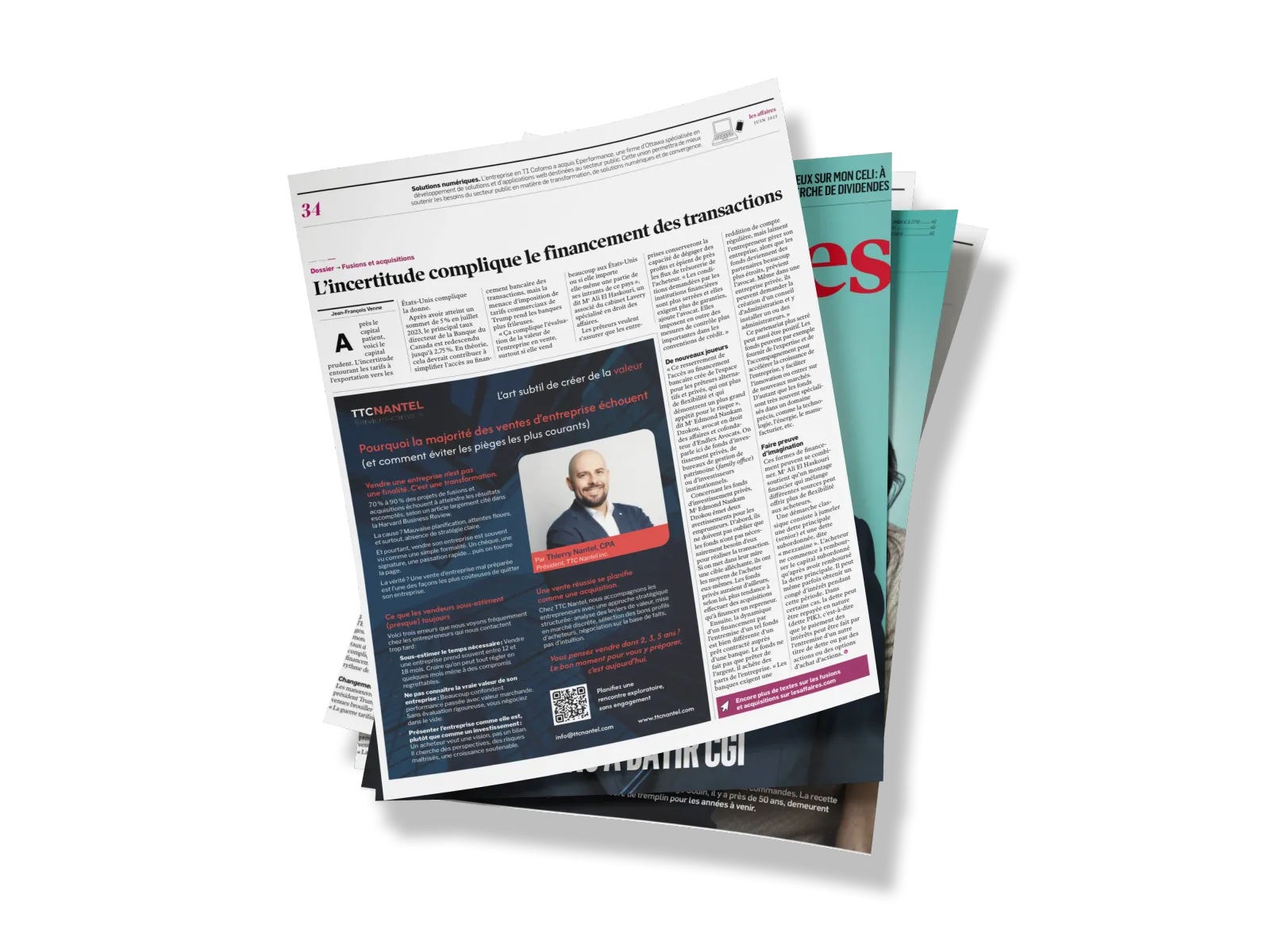
Meet the team →The business newspaper Les Affaires featured TTC Nantel's approach to business valuation (article in French).
A free, confidential preliminary call to understand your situation.
Book a confidential call